
Raw Material Traceability: Track Every Batch From GRN to Dispatch (2026)
How raw-material traceability lets Indian manufacturers track every batch from GRN to dispatch in 2026. Guide.
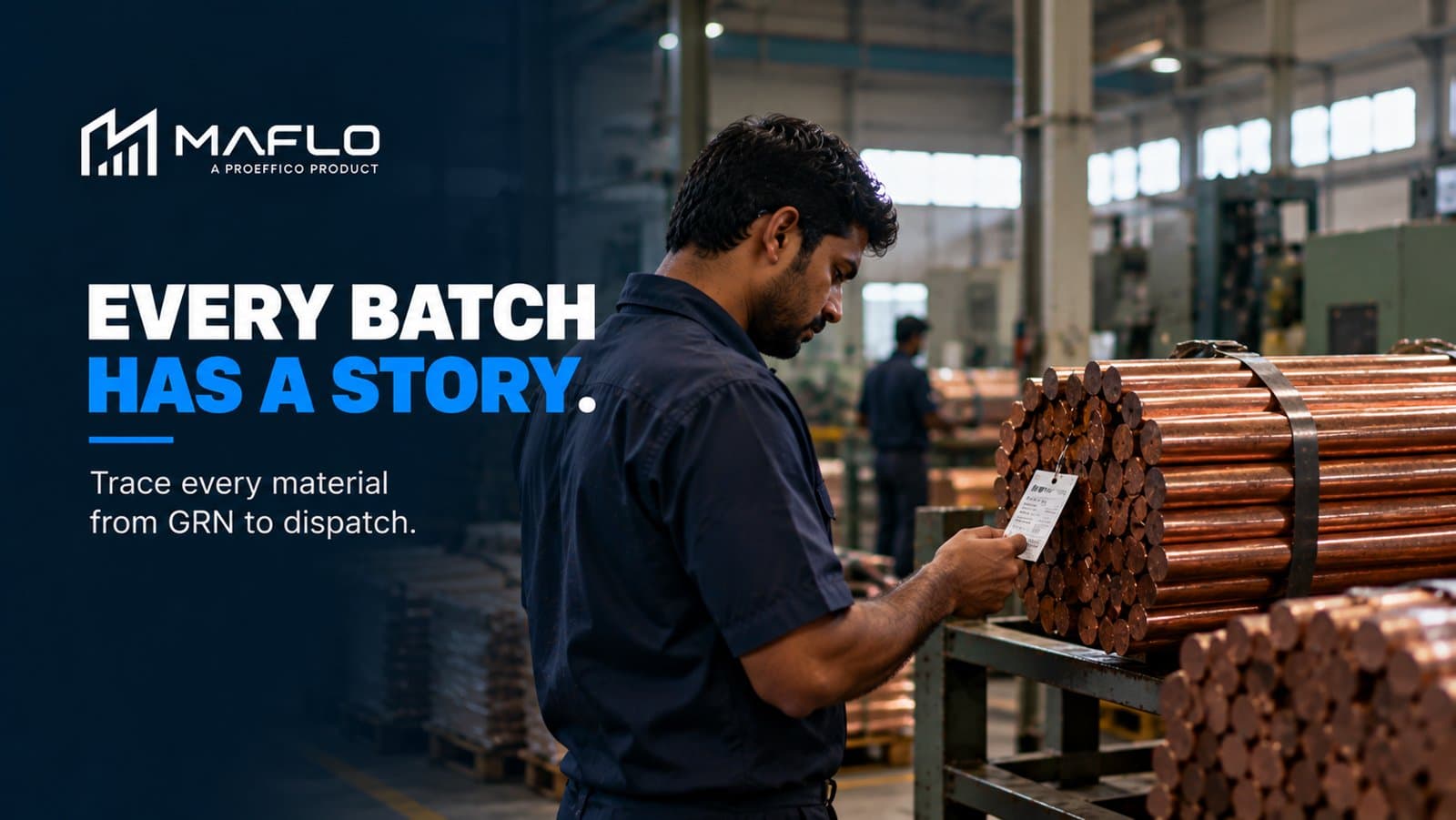
Ask a plant head which batch of resin, PVC compound, or copper rod went into last Tuesday's production run, and the honest answer at most MSME manufacturers is a shrug followed by a search through GRN registers and handwritten issue slips. Raw material traceability manufacturing isn't a compliance checkbox anymore — it's the difference between a two-hour recall and a two-week one, and between a customer complaint you can resolve in an afternoon and one that turns into a legal dispute.
Why traceability matters beyond audits
Most Indian manufacturers first hear the word "traceability" from an auditor or a large OEM customer's vendor questionnaire. That's a fair entry point, but it undersells what traceability actually does day to day.
When a batch of raw material — a drum of resin, a coil of copper, a roll of laminate paper — can't be traced forward into WIP and finished goods, a plant loses three things quietly:
- Root-cause speed. A quality issue on the floor takes hours or days to trace back to a specific vendor lot, instead of minutes.
- Negotiating leverage. Without proof that a defect traces to a specific incoming lot, it's hard to push a claim back on the supplier.
- Customer trust. When a customer reports a field failure, "we're checking our records" is not the answer that keeps the account.
Traceability also matters internally, well before anything goes wrong. Knowing exactly which lots are sitting in stores, which are partially consumed, and which have crossed their shelf life or re-test date is basic inventory hygiene — and it's exactly where most spreadsheet-and-register systems fall apart, because nobody wants to manually type lot numbers into three different logbooks for every issue.
From GRN to WIP to dispatch
Traceability breaks down into a chain, and it's only as strong as its weakest link. The chain runs:
- GRN (Goods Receipt Note) — material arrives, a lot/batch number is assigned (or captured from the vendor's own batch marking), and it's logged with vendor, quantity, date, and any QC parameters.
- Stores issue — when material moves to the shop floor for a production order, the specific lot(s) issued must be recorded against that order, not just "material issued."
- WIP consumption — as material is processed, converted, or blended, the traceability record should carry forward: which input lots went into which intermediate or output batch.
- Finished goods and dispatch — the finished lot is packed, labeled, and dispatched against a specific customer order, with the full upstream chain still attached.
On paper this looks straightforward. In practice, the break usually happens at step 2 — stores issue. GRN registers are often maintained reasonably well because they're the accounting trigger. But once material leaves the store, the paper trail thins out fast. A helper picks up "a drum of resin" for a batch, and unless someone is disciplined about writing down which drum (which lot), that link is gone forever. This is precisely the gap MAFLO's inventory and production modules are built to close — the lot number travels with the material through stores issue, into the production order, and out the other side as a finished-goods lot, without depending on someone remembering to write it down.
Batch and lot tracking
"Batch" and "lot" get used loosely, but the distinction matters operationally:
- A lot is typically what arrived together from a vendor on one GRN — same source, same date, same set of QC results.
- A batch is often the manufacturing unit — one mixing batch, one extrusion run, one curing cycle — which may consume material from one or more incoming lots.
Good traceability software needs to handle both, and needs to handle many-to-many relationships cleanly: one finished batch consumed from three raw material lots; one raw material lot spread across five finished batches over a month. Spreadsheets handle one-to-one relationships fine. They fall apart on many-to-many, which is exactly the real shape of a manufacturing plant's material flow.
For process-heavy industries — resins and chemicals with mixing tanks, wire and cable with continuous drawing and extrusion — this many-to-many reality is the norm, not the exception. A single day's extrusion run might draw from two or three copper rod lots as one runs out and the next is loaded. Traceability has to capture that split, not average it away.
Practically, this means:
- Every lot gets a unique, scannable identifier (barcode or QR) at GRN.
- Stores issue is recorded against production orders by lot, not just by item code.
- WIP transformation records preserve the lot lineage — what went in, what came out.
- Shelf-life and re-test dates are tracked per lot, with alerts before expiry, not after.
Recalls, quality and accountability
The real test of a traceability system is the day something goes wrong. When a customer flags a defect, the question is always the same: how far does it spread, and how fast can it be contained?
With proper batch traceability, a plant can answer in minutes: which finished-goods batches used the suspect raw material lot, which customer orders those batches shipped against, and what quantity is still in stores or in transit versus already in the field. Without it, the safe (and expensive) response is often a blanket recall or a blanket hold across weeks of production, because there's no way to narrow it down.
Traceability also sharpens internal accountability in ways that aren't just about external recalls:
- Vendor quality trends become visible — if defects trace back disproportionately to one supplier's lots, that's a data-backed conversation, not a hunch.
- Shift and machine correlation — if traceability is linked to production order data (who ran it, on which line, on which shift), quality issues can be correlated to process factors, not just material.
- Customer-specific audit trails — for customers who require lot-level certificates of conformance (common in wire and cable, electrical components, and increasingly in laminates supplying export-oriented furniture makers), the paperwork is generated from the same trail instead of assembled by hand each time.
This is also where traceability connects to production planning and shop-floor visibility more broadly — a lot that's flagged as on-hold shouldn't be schedulable into a production order in the first place. That's a planning problem as much as a traceability one; see MAFLO's approach to production planning software for MSME manufacturers for how the two connect. Traceability data is also one of the inputs that feeds a genuine picture of plant performance — alongside metrics like OEE monitoring for small factories, which looks at availability, performance, and quality losses on the same production orders that traceability is tracking materials through.
Getting started
Full end-to-end traceability doesn't need to be a six-month project before it delivers value. A sensible sequence for most MSME manufacturers:
- Start with GRN discipline. Make sure every incoming lot gets a unique identifier and is logged against the vendor and date — this is the foundation everything else depends on.
- Fix the stores-issue gap. This is the single highest-leverage step: require lot selection at issue time, even if it's just a barcode scan against a production order.
- Add WIP linkage for your highest-risk material. Not every SKU needs full traceability on day one — start with the material where a recall or quality claim would hurt most (often the highest-value or safety-critical inputs).
- Connect it to dispatch. Close the loop so the finished-goods lot leaving the dock still carries its full upstream lineage.
- Review it, don't just record it. Traceability data is only useful if someone looks at vendor-lot quality trends and shelf-life alerts regularly, not just when an auditor asks.
An anonymized example from Proeffico's manufacturing engagements: an electrical products manufacturer had no digital way to verify which production lot a given finished unit belonged to, or where its raw material had come from — inventory reconciliation was entirely manual and reactive. Moving to QR-tagged lot tracking at receipt, with the code carried through to the finished product, gave the company real-time visibility into stock movement for the first time and cut the manual reconciliation effort that had been eating operations time every week. The pattern holds across sectors — a pharmaceutical distributor that MAFLO's parent company worked with saw a similar shift once batch and expiry data was built into the inventory system directly, rather than tracked in a separate register that nobody cross-checked in time.
Frequently Asked Questions
What's the difference between raw material traceability and general inventory management?
Inventory management tells you how much of an item you have. Traceability tells you which specific lot or batch that quantity belongs to, where it came from, and — once consumed — which finished goods it went into. You can have accurate inventory counts and still have zero traceability if lot-level detail isn't captured at issue and consumption.
Do small manufacturers really need lot-level traceability, or is this only for large OEM suppliers?
Any manufacturer that has faced a customer quality complaint, a vendor dispute, or a shelf-life-sensitive material (resins, adhesives, certain chemicals) benefits from it, regardless of size. It becomes non-negotiable once you supply customers who require batch certificates of conformance, but the internal value — faster root-cause, tighter vendor accountability — applies at any scale.
How does traceability work for process manufacturing, like mixing or extrusion, where materials get blended?
The system needs to track many-to-many relationships: multiple incoming lots feeding one production batch, and one lot potentially spread across multiple batches. The record that matters is the lineage — which input lots contributed to which output batch — rather than trying to trace a single physical unit end to end, which isn't possible once material is blended or extruded.
What's the minimum first step if we're starting from paper registers today?
Fix GRN and stores issue first. If every incoming lot gets a unique ID and every issue to the shop floor is recorded against a specific lot (not just an item code), you already have the two hardest links in the chain covered. WIP and dispatch linkage can follow once that habit is in place.
Does raw material traceability require barcode or QR hardware on the shop floor?
Not necessarily to start — lot numbers can be captured manually against production orders in a digital system. Barcode or QR scanning speeds up capture and reduces data-entry errors significantly, and is worth adding once the process itself is established, but it's an accelerant, not a prerequisite.
See MAFLO on your data book a walkthrough