
Software for Wire & Cable Manufacturers in India: Visibility Across the Floor (2026)
How wire and cable manufacturers in India get end-to-end floor visibility - from drawing to dispatch - in 2026.
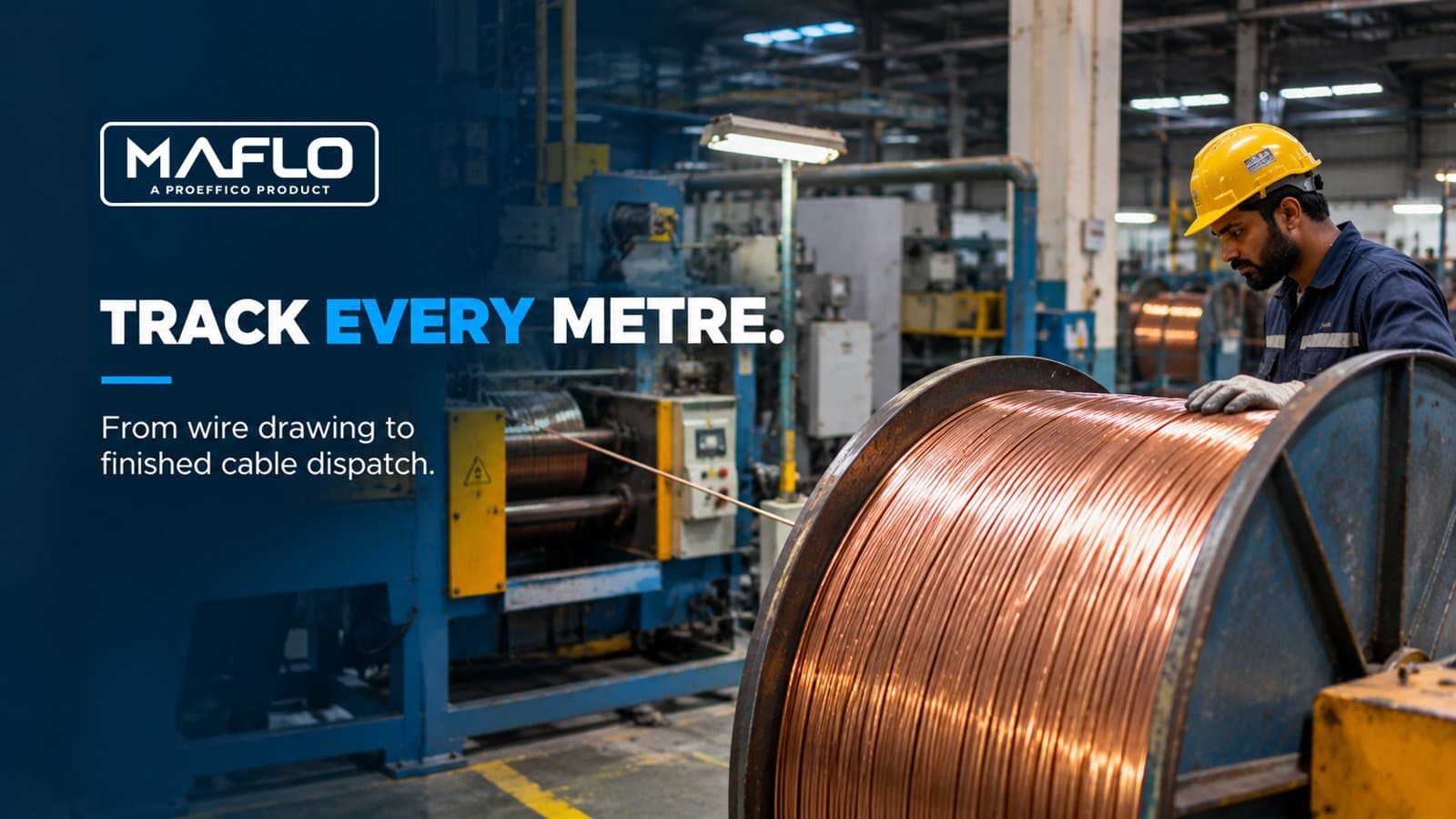
Wire and cable is one of the few industries where a single order can pass through drawing, stranding, insulation, sheathing, armouring, and testing before it's anywhere near dispatch — and at every one of those stages, the product itself changes form, length, and even identity. That's exactly why most wire cable manufacturing software India searches lead back to generic ERPs that were never built for continuous-process manufacturing. This is where visibility, not just record-keeping, becomes the real problem to solve. ## Why wire & cable plants are hard to see Ask a plant head how much copper went into today's production run and you'll usually get an estimate, not a number. That's not a knock on the team — it's the nature of the process. A single coil of wire rod enters drawing and comes out as multiple bobbins at different gauges. Those bobbins feed into stranding and insulation lines where lengths shrink again through pay-off and take-up losses. By the time a finished cable reaches the dispatch bay, it has passed through four or five work centers, each with its own scrap, its own rework, and its own operator log — usually on paper or in a shift-end Excel sheet. Most ERP systems track this as a single "production order" with a start and end quantity. They don't see the intermediate states — the WIP sitting between drawing and stranding, the half-used bobbins parked next to a machine, the difference between rated length and actual length after testing. That gap between what the ERP says and what's actually on the floor is where MSME wire & cable manufacturers lose the most time, and the most material. The result is familiar to anyone who has run a cable plant: month-end stock reconciliation that never quite matches, yield numbers that get argued over between production and finance, and a planning team that's scheduling the next week's orders on gut feel because the actual floor status is a day or two old by the time it reaches them. ## Tracking continuous and batch processes Wire & cable manufacturing is a mix of continuous processes (drawing, extrusion) and batch/discrete steps (stranding, armouring, coiling, testing) — and a system built only for one or the other misses half the floor. MAFLO tracks production at the process-stage level rather than as one blanket order, which means: - Drawing and extrusion runs are logged by machine, shift, and output length/weight — not just a daily total. - Stranding and insulation stages carry forward the actual input from the previous stage (not the planned quantity), so line loss shows up immediately instead of at month-end. - Batch identity is preserved as material moves between stages, so a defect or deviation found at testing can be traced back to the specific drawing run and copper lot it came from. - Machine-wise and shift-wise output is visible in near real time, not reconstructed from log books days later. This matters more in wire & cable than in most other manufacturing sectors because the raw material cost (copper, aluminium, PVC/XLPE compounds) is such a large share of the finished product cost. A 2-3% yield variance that goes unnoticed for a quarter is a material amount of money quietly leaking out of the plant — and it's invisible in a system that only tracks order-level totals. ## Material, scrap and yield visibility Copper and aluminium prices move; your margins shouldn't be the thing absorbing every swing silently. Yield visibility is the single biggest lever most wire & cable manufacturers under-use, mostly because the data to act on it isn't captured in a usable form. What actually needs tracking, stage by stage: - Input vs. output by weight/length at drawing, stranding, and insulation — not just at the finished-goods stage. - Scrap reason codes — die failure, breakage, quality rejection, changeover loss — logged at the point of occurrence, not guessed at during month-end audit. - Rework and downgrade quantities, since cable that fails one spec often gets diverted to a lower grade rather than scrapped outright, and that diversion needs to be visible for costing to be accurate. - Bobbin- and coil-level tracking, since partial bobbins re-enter the next stage as WIP and are a common source of "missing" inventory in physical counts. This is the same discipline covered in more depth in MAFLO's guide to raw material traceability — the principle of tracking every batch from GRN to dispatch applies directly to copper/aluminium lots and compound batches in a cable plant, and it's what makes a recall or a customer quality query something you can answer in minutes rather than days. Yield and scrap data is also where OEE-style thinking pays off on continuous lines, even if a full isn't something every plant tracks formally yet. ## Connecting floor to planning Visibility on the floor is only half the value — the other half is what happens when that data actually reaches the planning desk in time to matter. In most MSME wire & cable plants, production planning runs a day or more behind reality. The planner is scheduling tomorrow's die changes and machine allocations based on yesterday's shift report, not this morning's actual output. That lag compounds: a die change that should have been flagged at 10am gets discovered at the evening shift handover, and the next day's schedule slips again. Connecting floor data to planning closes that loop. When actual output, scrap, and machine status from drawing and stranding feed directly into the production schedule, planning can react to what's actually happening — reallocating a delayed order to a free machine, or flagging a copper shortage before it stalls a line rather than after. This is the same shift from guesswork to a live plan covered in MAFLO's piece on production planning software for MSME manufacturers, and it's especially relevant for wire & cable given how many sequential stages a single order has to pass through before it's shippable. The downtime side of this matters just as much — a die change, a breakage, or a machine stoppage that isn't logged with a reason code is downtime you can't fix because you can't see it. MAFLO's approach to manufacturing downtime tracking is built around capturing reasons at the point of occurrence, which is what turns a downtime log from a compliance exercise into something the plant actually acts on. ## Getting started Most wire & cable manufacturers don't need to rip out their existing ERP or accounting system to get this kind of visibility — MAFLO is built to sit alongside Tally or an existing ERP and fill the shop-floor gap, not replace the finance stack. A sensible starting point: 1. Map your actual process stages — drawing, stranding, insulation, sheathing, armouring, testing, packing — and identify where material or time visibility is currently weakest. 2. Start with one line or one product family rather than the whole plant, so the team can validate the numbers against what they already know before scaling up. 3. Get a Manufacturing Leakage Audit — a walkthrough of where inventory, production, quality, and dispatch data is currently leaking or lagging, specific to your plant layout. 4. See MAFLO against your own production data, not a demo dataset, so the yield and scrap numbers it surfaces are ones your team can immediately recognize (or challenge). ## Frequently Asked Questions ### Does MAFLO replace our existing ERP or Tally? No. MAFLO is designed to work alongside your existing accounting/ERP system, focusing specifically on shop-floor visibility — production, material flow, scrap, and machine status — that most finance-oriented ERPs don't capture in enough detail for process manufacturing. ### Can it handle both continuous processes like drawing/extrusion and discrete steps like armouring? Yes. Wire & cable is inherently a mix of continuous and batch/discrete stages, and MAFLO tracks production at the process-stage level so both types of operations are visible in the same system rather than needing separate tools. ### How long does it take to see results? This depends on plant complexity and how many process stages are in scope for the initial rollout. Starting with a single line or product family, as recommended above, typically shows usable visibility faster than attempting a full-plant rollout on day one. ### What size of wire & cable manufacturer is MAFLO built for? MAFLO is built primarily for Indian MSME manufacturers — plants that have outgrown spreadsheets and shift-end paper logs but don't need (or can't justify the cost and complexity of) a large enterprise MES/ERP suite. ### Can it trace a finished cable batch back to the copper lot it came from? Yes — batch and lot identity is carried forward as material moves through drawing, stranding, and insulation stages, so a quality issue or customer query at the finished-goods stage can be traced back to the originating raw material batch. If your plant is still reconciling yield and scrap at month-end instead of in real time, [See MAFLO on your data book a walkthrough and find out what's actually happening on your floor between drawing and dispatch.